
 Live Radio





Feed from KRCB News
- Written by: Kacey Sycamore
 When Jorge Newbery finally got through to his 95-year-old mother, Jennifer, on a video call April 18, she could barely talk or move and her eyes couldn’t focus.
It was the first time he had seen her since California nursing homes shut their doors to visitors a month earlier. Immediately after the video chat, Newbery called the front desk in a panic.
“I said, ‘You gotta get her out, you gotta call 911,’” he recalled. “She’s looking like she’s about to die.”
Newbery’s mother was living at the Rehabilitation Center of Santa Monica, one of 198 nursing homes in California where at least one patient had contracted the coronavirus as of April 28, public health records show. The outbreak at the Rehabilitation Center has been worse than most, with 12 employees and 24 patients infected, including nine fatalities, according to the Los Angeles County health department.
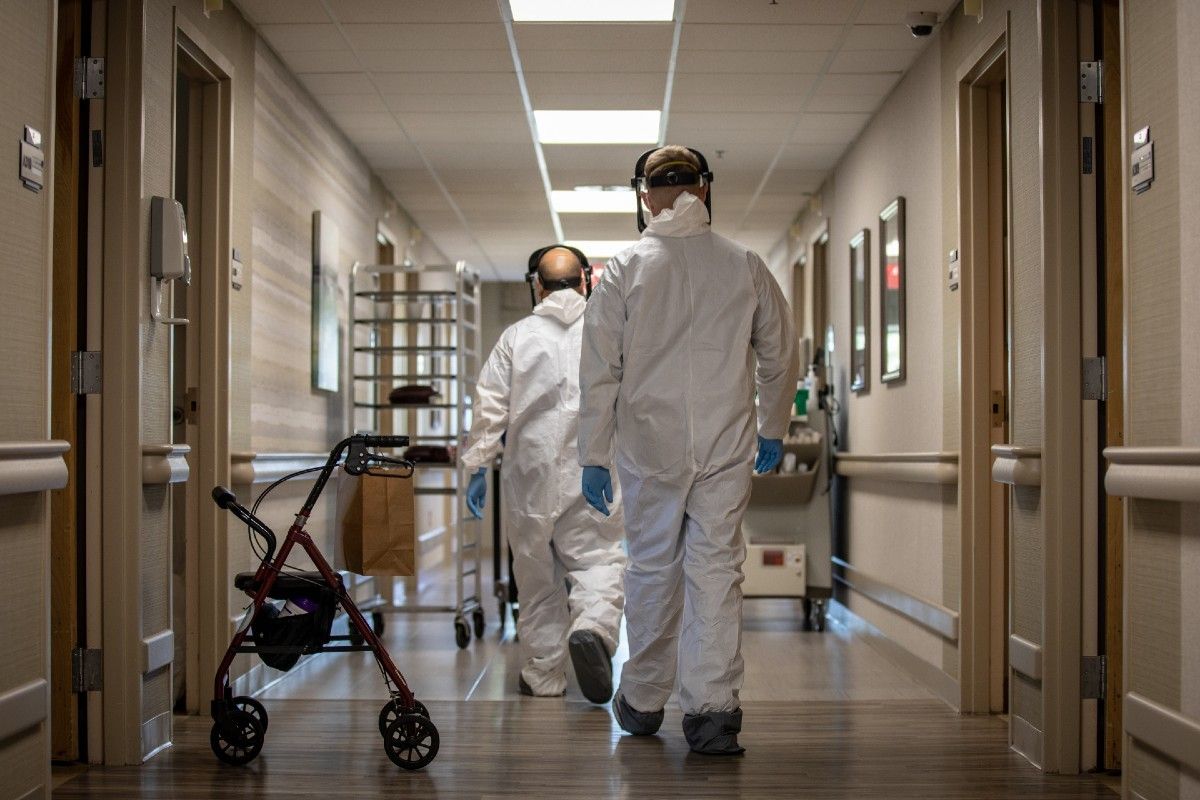
(Image: Sgt. Nicholas Shepherd, a practical nursing specialist, and Maj. Rahul Vedprakash, assigned to Urban Augmentation Medical Task Force 352-2, walk down a hallway to the next patient at the Royal Suites Healthcare & Rehabilitation Center in Galloway Township, N.J., May 5, 2020. U.S. Army photo by Spc. Miguel Pena)
The Rehabilitation Center shares several other worrisome characteristics with many other homes beset by coronavirus infections: Historically, it has had lower-than-average staffing levels and a record of not always following basic staffing and infection control rules, a Kaiser Health News analysis shows.
Compared with homes reporting no patient infections, California facilities with one or more patients with a COVID-19 case had on average a 25% fewer registered nurses per resident in the final three months of 2019, the last period for which the federal government has published data.
In addition, 91% of nursing homes reporting at least one case of the virus had a previous health violation for not following infection control rules, while 81% of homes without reported cases had such violations. Typical violations included nurses or aides not washing their hands or wearing protective clothing around potentially contagious patients.
“With low RN staffing, it is not surprising that these facilities have had previous violations for infection control and poorer overall quality as measured by having more deficiencies,” said Charlene Harrington, a professor emerita of the School of Nursing at the University of California-San Francisco. “It is a classic situation that reaffirms what researchers have found previously, only the situation with the COVID-19 virus is far more serious than anything the nursing homes have experienced before.”
In an email, Jeffrey Huang, the administrator of the Rehabilitation Center of Santa Monica, said “we respectfully and strongly disagree” that Medicare assessments of the home’s quality predict or reflect the nursing home’s efforts to protect residents from the coronavirus. The staff was “continuing to do everything possible for keeping our residents and staff safe in these uncertain times,” Huang wrote. He declined to discuss Newbery, citing patient confidentiality.
Nursing homes have emerged as one of the places the coronavirus spreads most aggressively. In California, 4,711 nursing home residents had been infected and 663 had died by the end of April, about a third of all COVID-19-linked deaths that homes in the state have reported to authorities.
The KHN analysis is the first to compare Medicare’s public quality measures for the 198 California nursing homes that registered coronavirus cases by late April with the 983 homes with no cases reported to either the state public health department or Los Angeles County, where a majority of homes with infections are located. KHN found that California homes with coronavirus cases averaged 2.8 stars on Medicare’s five-star overall quality rating, while other homes averaged 3.5 stars.
On average, the homes that have had coronavirus cases had more complaints lodged against them and were fined 29% times more often. In addition, Medicare also calculated that their health violations of all types were 20% more serious. They also tended to be larger, averaging 105 patients versus 83 on the homes without virus cases.
The analysis found no substantial difference in the homes’ numbers of nurse aides or licensed practical nurses, but fewer registered nurses, who have the most medical training and supervise the other caregivers. On average, there was one registered nurse for every 39 residents at a California home without a patient coronavirus infection versus one RN for every 52 residents for homes with infections, KHN’s analysis found.
Certainly, nursing homes with stellar quality ratings also have had coronavirus outbreaks. Nursing Home Compare, the federal government’s consumer website, gave its top overall rating of five stars to Life Care of Kirkland, the Seattle-area nursing home that was the first reported to have a slew of infections. In California, 12 of the nursing homes with coronavirus infections had above-average ratings for both staffing levels and inspection results, although only three had no history of infection control citations.
The prevalence of coronavirus infections in lower-rated nursing homes could be explained by poorer care, but there might be other factors, said David Grabowski, a professor of health policy at Harvard Medical School. For instance, the lower-rated homes might be primarily located in low-income areas with high rates of coronavirus cases in those neighborhoods, he said.
“This suggests a very different set of policies if we want to protect nursing homes from further outbreaks,” Grabowski said.
Representatives of nursing homes rated as below average on Nursing Home Compare say that the coronavirus has thrown everyone off guard and that registered nurse staffing levels are irrelevant to whether a patient is infected by the new virus.
“It’s really hard to draw a straight line from” issues raised in previous years’ inspections “to this pandemic that even the experts didn’t see coming and were not prepared for,” said Elizabeth Tyler, a spokesperson for Longwood Management Corp., which runs three nursing homes with coronavirus infections that were also poorly rated before the pandemic: Studio City Rehabilitation Center, Burbank Healthcare and Rehabilitation Center and Sunnyview Care Center.
Burbank and Sunnyview have a health inspection rating of one out of five stars, which is much below average, while Studio City has two stars. Tyler said that health inspection ratings are a “very, very complex system” taking into account hundreds of different factors, and she hesitated to make any connections between past reviews or staffing levels and the current outbreak.
Lakeview Terrace in Los Angeles, which has recorded three cases of COVID-19, has been on a list of 15,000 nursing homes around the nation that health inspectors are required to visit more frequently because of repeated violations of patient safety rules. It has an overall Medicare rating of one of five stars — the lowest rating — and almost six times the national average of health deficiencies.
In August 2019, inspectors faulted the home after they saw a nursing assistant deliver a breakfast tray into an isolation room without putting on personal protective equipment. They also discovered the home was not keeping logs to track signs and symptoms of possible infections.
DJ Weaver, an administrator for Lakeview Terrace, said that on the rare occasion that mistakes happen, the facility counsels and trains staff and makes systemic improvements to prevent future occurrences.
“Overall, we have done a good job not allowing cross-contamination of any infectious organisms, which is the real danger,” Weaver said in an emailed statement.
Lakeview’s cases came as a result of accepting a hospital patient who had undiagnosed COVID-19, Weaver said. His infection of two roommates couldn’t have been prevented by the facility’s policies designed to protect residents from the virus. Those include banning staff from working at multiple nursing homes and suspending group dining and activities.
“That kind of thing is really hard to foresee,” Weaver said.
Jennifer Newbery entered the Rehabilitation Center of Santa Monica in April 2019. Up until the day of the video conversation, Jorge Newbery said he and his four siblings had been told by staff that the nursing home had only three cases of COVID-19, and that everything was under control.
But after the home transferred Jennifer Newbery to a local hospital, doctors told her family she tested positive for the coronavirus and had pneumonia, Newbery said.
When Newbery later called to thank the staffer for facilitating the video chat, he asked if the facility had seen any deaths.
The staffer said yes, Newbery recalled, and it floored him. “We absolutely had no idea,” he said.
Newbery said his mom is getting better at UCLA Medical Center Santa Monica. After she’s discharged, Jorge wants to take her to Chicago to live with him and his family.
Newbery said he had been unaware of Medicare’s critical assessment of the Rehabilitation Center, which has two stars out of five overall on Nursing Home Compare, denoting below-average care. Inspection records show that during a visit in May 2019, health inspectors faulted it for failing to sanitize a blood pressure cuff before it was used on a second patient, and for allowing a urinary drainage bag attached to a catheter to be touching the floor. In August 2019, inspectors determined the home violated California’s minimum staffing requirements because it lacked enough nurse assistants on 10 out of 24 days.
Huang, the administrator, noted Medicare gave the facility five stars, the best rating, in a quality category that assesses things like the frequency of patient trips to the hospital or emergency room and homes’ self-reported assessments of how often residents improved during their stays. The regulators who issued the May 2019 deficiency found no evidence of harm to a resident, he said.
Michael Connors, an advocate with the California Advocates for Nursing Home Reform, said nursing homes with fewer staff members and poor compliance with infection control practices are ripe for the spread of the virus.
“No place could be more dangerous to live right now,” Connors said. “It’s these characteristics that make nursing homes ground zero for COVID-19 outbreaks and deaths.”
- Written by: Kacey Sycamore
 As many states begin to reopen — most without meeting the thresholds recommended by the White House — a new level of COVID-19 risk analysis begins for Americans.
Should I go to the beach? What about the hair salon? A sit-down restaurant meal? Visit Mom on Mother’s Day?
States are responding to the tremendous economic cost of the pandemic and people’s pent-up desire to be “normal” again. But public health experts remain cautious. In many areas, they note, COVID cases — and deaths — are still on the rise, and some fear new surges will follow the easing of restrictions.
“Reopening is not back to normal. It is trying to find ways to allow people to get back out to do things they want to do, and business to do business,” said Dr. Marcus Plescia, chief medical officer at the Association of State and Territorial Health Officials. “We can’t pretend the virus has gone away. The vast majority of the population is still susceptible.”
(Image: Lidvina Mikulic, Army and Air Force Exchange Service concessionaire, helps a customer at the Base Exchange at Ramstein Air Base, Germany, April 21, 2020. U.S. Air Force photo by Senior Airman Elizabeth Baker)
So far, state rules vary. But they involve a basic theme.
“They are making assumptions that people will use common sense and good public health practice when they go out,” said Dr. Georges Benjamin, executive director with the American Public Health Association.
As states start to reopen, people will have to weigh the risk versus benefit of getting out more, along with their own tolerance for uncertainty. The bottom line, health experts say, is people should continue to be vigilant: Maintain distance, wear masks, wash your hands — and take responsibility for your own health and that of those around you.
“It’s clearly too early, in my mind, in many places to pull the stay-at-home rules,” said Benjamin. “But, to the extent that is going to happen, we have to give people advice to do it safely. No one should interpret my comments as being overly supportive of doing it, but if you’re going to do it, you have to be careful.”
An added caveat: All advice applies to people at normal risk of weathering the disease. Those 60 or older and people with underlying health conditions or compromised immune systems should continue staying home.
“Folks who are at higher risk of having a more severe reaction have to continue to be very careful and limit contact with other people,” Plescia said.
So, should I go to the beach?
There’s nothing inherently risky about the beach, said Benjamin. But, again, “if you can, avoid crowds,” he said. “Have as few people around you as possible.”
Maintain that 6-foot distance, even in the water.
“If you are standing close and interacting, there is a chance they could be sick and they may not know it and you could catch it,” Plescia said. “The whole 6-foot distance is a good thing to remember going forward.”
Still, “one thing about the beach or anywhere outside is that there is a lot of good air movement, which is very different than standing in a crowded subway car,” he said.
Even so, recent images of packed beaches and parks raise questions about whether people are able or willing to continue heeding distancing directives.
But if we’re all wearing masks, do we really need to stay 6 feet apart?
Yes, for two reasons. First, while masks can reduce the amount of droplets expelled from the mouth and nose, they aren’t perfect.
Droplets from sneezing, coughing or possibly even talking are considered the main way the coronavirus is transmitted, from landing either on another person or surface. Those who touch that surface may be at risk of infection if they then touch their face, especially the eyes or mouth. “By wearing a mask, I reduce the amount of particles I express out of my mouth,” said Benjamin. “I try to protect you from me, but it also protects me from you.”
And, second, masks don’t protect your eyes. Since the virus can enter the body through the eyes, standing further apart also reduces that risk.
Should I visit Mom on Mother’s Day?
This is a complex choice for many families. Obviously, if Mom is in a nursing home or assisted living, the answer is clearly no, as most care facilities are closed to visitors because the virus has been devastating that population.
There’s still risk beyond such venues. Data from the Centers for Disease Control and Prevention shows 8 out of 10 reported deaths from the coronavirus are among those 65 or older. Underlying conditions, such as heart or lung disease and diabetes, appear to play a role, and older adults are more likely to have such conditions.
So, what if Mom is healthy? There’s no easy answer, public health experts say, because how the virus affects any individual is unpredictable. And visitors may be infected and not know it. An estimated 25% of people show no or few symptoms.
“A virtual gathering is a much safer alternative this year,” said Benjamin.
But if your family insists on an in-person Mother’s Day after weighing Mom’s health (and Dad’s, too, if he’s there), “everyone in the family should do a health check before gathering,” he said. “No one with any COVID symptoms or a fever should participate.”
How prevalent COVID is in your region is also a consideration, experts say, as is how much contact you and your other family members have had with other people.
If you do visit Mom, wear masks and refrain from hugging, kissing or other close contact, Benjamin said.
My hair is a mess. What about going to the salon?
Again, no clear answer. As salons and barbershops reopen in some states, they are taking precautions.
States and professional associations are recommending requiring reservations, limiting the number of customers inside the shop at a given time, installing Plexiglas barriers between stations, cleaning the chairs, sinks and other surfaces often, and having stylists and customers wear masks. Ask what steps your salon is taking.
“Employees should stay home if they are sick or in contact with someone who is sick,” said Dr. Amanda Castel, professor of epidemiology at Milken Institute School of Public Health at the George Washington University. “Also, employers should make sure they don’t have everyone congregating in the kitchen or break room.”
Some salons or barbers are cutting hair outside, she noted, which may reduce the risk because of better ventilation. Salons should also keep track of the customers they see, just in case they need to contact them later, should there be a reason to suspect a client or stylist had become infected, Castel said.
Consider limiting chitchat during the cut, said Plescia, as talking in close proximity may increase your risk, although “it feels a little rude,” he admitted.
What if your stylist is coughing and sneezing?
“I would leave immediately,” he said.
What about dining at a restaurant?
Many states and the CDC have recommendations for restaurants that limit capacity — some states say 25% — in addition to setting tables well apart, using disposable menus and single-serve condiments, and requiring wait staff to wear masks.
“That’s the kind of thing that does help reduce the chance of spread of infection,” Plescia said.
If your favorite eatery is opening, call to ask what precautions are in place. Make a reservation and “be thoughtful about who you are having dinner with,” said Plescia. Household members are one thing, but “getting into closer physical contact with friends is something people should be cautious about.”
Overall, decide how comfortable you are with the concept.
“If you’re going to go to a restaurant just to sit around and worry, then you might as well do takeout,” he said.
And travel?
Consider your options and whether you really need to go, say experts.
Driving and staying in a hotel may be an option for some people.
If hotels are adequately cleaned between guests, “you could make that work,” said Plescia. Bring cleaning wipes and even your own pillows. Again, though, “if you’re going to see an elderly parent, you don’t want to contract something on the way and give it to them.”
Regarding air travel — airlines are taking steps, such as doing deep cleaning between flights. Fresh and recirculated air goes through special HEPA filters. While there is little specific research yet on the coronavirus and air travel, studies on other respiratory and infectious diseases have generally concluded the overall risk is low, except for people within two rows of the infected person. But a case involving an earlier type of coronavirus seemed to indicate wider possible spread across several rows.
Maintaining distance on the plane and in the boarding process is key.
“Wear a mask on the plane,” said Benjamin.
And plan ahead. How prevalent is the coronavirus in the areas you are traveling to and from? Are there any requirements that you self-isolate upon arrival? How will you get to and from the airport while minimizing your proximity to others?
But if it’s not essential, you might want to think twice right now.
“People who absolutely don’t have to travel should avoid doing it,” said Plescia.
Worship services are important to me. What precautions should be considered?
The distance rule applies as houses of worship consider reopening.
“As much as you can within religious rules, try to avoid contact,” said Benjamin.
He is not giving any advice on Holy Communion, saying that is up to religious leaders. But, he noted, “drinking from the same cup raises the risk if a person is sick or items are touched by anyone who is sick.”
Finally, keep in mind that much is being learned about the virus every day, from treatments to side effects to how it spreads.
“My own personal approach is, try to play it on the cautious side a bit longer,” said Plescia.
Castel agreed.
“We need a little more time to fully understand how COVID-19 works and more time to ramp up our testing, find treatments and hopefully a vaccine,” she said. “We all have social distancing fatigue. But we can continue to save lives by doing this.”
Kaiser Health News (KHN) is a national health policy news service. It is an editorially independent program of the Henry J. Kaiser Family Foundation which is not affiliated with Kaiser Permanente.
- Written by: Kacey Sycamore
By Laurel Rosenhall, CalMatters
 California lawmakers plan to probe why state officials wired half a billion dollars for masks to a medical supply company that had existed for just three days, and want to know what’s changed in the state’s vetting process since the deal collapsed.
“We really need to ensure that there are appropriate controls in place and that we are spending California’s tax dollars efficiently and responsibly,” said Assemblywoman Cottie Petrie-Norris, a Laguna Beach Democrat.
The accountability and administrative review committee she chairs plans to hold a hearing this month to examine the bizarre transaction that CalMatters revealed earlier this week in which California wired $456.9 million on March 26 to Blue Flame Medical LLC – then scrambled to get the money back hours later. The company was incorporated on March 23 by two Republican operatives, Mike Gula and John Thomas, with no track record in the medical supplies field.
(Image: California lawmakers are demanding details about the state's vetting of Blue Flame Medical and other sellers of supplies to combat the novel coronavirus. Photo by Anne Wernikoff for CalMatters)
Republican lawmakers also are seeking an audit of all the state’s spending on protective masks, including the rescinded payment to Blue Flame and a $1 billion contract the state subsequently reached with a Chinese company called BYD.
“We are concerned about the details of a rushed, half-billion contract to a company only days old and a price-per-mask contract with BYD that could be nearly 40% higher than what is available on the market,” nine GOP lawmakers wrote in a letter to the Legislature’s Democratic leaders Thursday.
“Rather than learning of these issues from the Administration… we are getting delayed and incomplete reports from news stories.”
The state decided to cancel the deal with Blue Flame for 100 million N95 masks after bankers involved in the wire transfer alerted California Treasurer Fiona Ma that they were suspicious of it, Ma told the Sacramento Bee. Ma declined an interview request from CalMatters.
The account she gave The Bee portrays a deal that was about to close until two bankers called her to raise alarms. One bank executive was not comfortable completing the transaction because the Blue Flame Medical account had been opened just the day before, according to The Bee’s report, and another banker involved in the wire transfer thought the transaction might be fraudulent and planned to call the FBI.
“That’s when I called the governor’s office and said, ‘this is fishy,’” Ma told The Bee. “‘We got the money back, but you need to vet these people better and go through the proper protocol.”
Newsom insisted Thursday that his administration has improved its vetting process since the Blue Flame deal fizzled in the initial weeks of California’s coronavirus crisis.
“We were in the Wild, Wild West period in the early part of this pandemic,” he said. “Those dollars were protected and protocols were put into place that are much more strengthened after that specific incident.”
Newsom’s director of Emergency Services said the vetting process now includes a team of experts in health, logistics and foreign commodities as well as federal emergency management and law enforcement officials. But he acknowledged that decision making during an emergency is rushed, and that state officials were deluged with offers from people purporting to have the coveted medical supplies.
“There were thousands and thousands of individuals and organizations reaching out to us that required all of these aspects to be vetted,” Mark Ghilarducci said.
“And through that vetting process we actually were only able to get through a small percentage of legitimate organizations and companies that could provide the commodities we needed.”
Because Newsom declared the pandemic an official emergency, the state has waived many of the normal rules for procuring supplies and services. Vendors can land lucrative contracts with the state without going through the usual bidding process.
One key lawmaker lauded Newsom’s handling of the pandemic and said he trusts the state’s leadership.
“There has been no pattern ever in this administration or these departments of recklessness that would make me want to suggest that there was anything improper,” said Sen. Bill Dodd, a Democrat from Napa, who chairs a committee overseeing disaster response.
It’s still not clear why Newsom administration officials decided to make the deal with Blue Flame in the first place, given how new the firm is to the medical supply business. The state’s Department of General Services, which placed the order with Blue Flame, did not respond to several inquiries from CalMatters over the last week and a half.
“I think it would be very productive both for the Legislature and also for the public at large to understand what happened,” said Assemblywoman Petrie-Norris.
At the upcoming hearing, she said she intends to ask Newsom’s aides: “What we have learned, what controls and protocols are now in place, are there still issues and gaps, and if so how are we working to close them?”
CalMatters.org is a nonprofit, nonpartisan media venture explaining California policies and politics.
- Written by: Kacey Sycamore
By Judy Lin, CalMatters
 California finance officials revealed a $54.3 billion deficit Thursday in the first economic assessment of the coronavirus pandemic’s devastating blow to the fifth-largest economy in the world.
That figure is higher than the deficit during the Great Recession and obliterates the state’s once-healthy reserves.
Without sugar-coating how hard the prolonged shutdown of businesses and job losses will hit the state, Gov. Gavin Newsom’s administration released bleak projections on key statewide indicators: 18% unemployment rate for the year, 21% drop in new housing permits and nearly 9% decline in California personal income.
(Image: In this file photo, Gov. Gavin Newsom presents the 2020-21 state budget at a press conference at the California Capitol on Jan. 10, 2020. Photo by Anne Wernikoff for CalMatters)
The California numbers signal a financial tsunami and cuts to schools, health care and safety-net programs, as state and local governments turn to the federal government for additional stimulus support. In one example, California’s public school system, including K-12 and community colleges, will lose $18 billion in the state’s minimum-funding guarantee, setting back years of striving to reach adequate education funding.
Newsom Thursday stressed once again that California had balanced its budget and headed into this year with a huge surplus — all undone by the pandemic. He said the state is resilient and can rebound, with a caveat.
“My optimism is conditioned on this — more federal support. We’re seeing economic numbers, unemployment numbers, more acute than anything we’ve seen in modern times,” he said. “We need the federal government to recognize this. We really need the federal government to do more.”
Lawmakers began to prioritize the programs they hope to protect. The Legislature will take up the budget after Newsom releases his proposal on May 14. Lawmakers will then have until June 15 to pass a balanced spending plan.
“I want to keep education as whole as possible,” Sen. Jerry Hill, a Democrat from San Mateo. Referring to deep cuts made during the last recession, he added, “we cannot abandon another generation of children.”
The governor had warned that the budget figures would be “jaw-dropping” and sought to brace the public for a prolonged recovery. Newsom struck a positive note: The state was in a better position to withstand the crisis because it paid down debt and built up reserves in good years.
Still, the deficit is three and a half times the state’s $16 billion rainy day fund and nearly 37% of the state’s general fund.
Officials from Los Angeles, San Francisco and Stockton wasted no time campaigning for a statewide tax increase. The Schools and Communities First campaign, led by labor and education groups, is pushing a November ballot measure to overhaul Proposition 13, California’s landmark property tax cap, to help prevent steeper cuts to local governments and public schools.
“I urge strongly everyone to endorse this measure because, again, we’re going to need revenue,” said Stockton Mayor Michael Tubbs.
It remains unclear how a recession will affect voters’ mood for a tax measure. Business and anti-tax groups have vowed vigorously to oppose the measure, saying it harms businesses.
The governor’s budget update projects California’s economic losses will fall disproportionately hard on low- and middle-income Californians, which will only exacerbate income inequality. At the same time, low-income households and people of color are at greater risk of contracting and dying from the virus as the number of confirmed cases reaches 60,000.
Since mid-March, Californians have filed more than 4.2 million unemployment claims.
“This is particularly concerning because the average income did not return to pre-Great Recession levels until 2018,” wrote the Department of Finance in its fiscal update Thursday.
It’s an about-face for a state that began the year with ambitions of expanding child care for working parents and health care for undocumented seniors. Compared to the budget Newsom released in January, the state’s three main revenue sources in the general fund are now projecting a 25.5% drop in personal income taxes, 27.2% drop in sales taxes and 22.7% drop in corporate taxes
The $54.3 billion deficit is driven by three factors: $41 billion in revenue loss, $7 billion increase in health and human services programs, mainly Medi-Cal, the state’s health program for the poor, and about $6 billion in additional spending, mainly driven by the state’s response to COVID-19. The Newsom administration’s response has come under scrutiny as lawmakers demand oversight of multi-million dollar contracts and federal investigators look into supply deals gone awry.
Now anti-poverty advocates are bracing for a deja vu.
The Great Recession led to deep, painful cuts to California’s social safety net — such as CalWorks, California’s welfare program for families with children, Supplemental Security Income for elderly and disabled people, and subsidized child care — even as unemployment and poverty spiked. Many social safety net programs are still less generous than they were in 2007.
“It’s devastating because at a time when people need government the most — which is any recession — it’s also the time when we have limited ability to help,” said Assemblyman Phil Ting, a San Francisco Democrat and chair of the budget committee.
Here’s how the deficit may impact major programs:
Housing and homelessness
Before the pandemic struck, California’s twin housing affordability and homelessness crises were at the top of Newsom’s 2020 agenda. The self-proclaimed setter of “big, hairy, audacious goals” devoted his entire State of the State to housing the more than 150,000 Californians living outside or in shelters, and vowed to enact a signature bill to ease the state’s housing shortage.
California will have to scale back those ambitions, including:
- A proposal from big city mayors for $2 billion a year in ongoing homelessness funding may be able to draw on federal dollars in the short term, but backers will have a difficult time answering where that money should come from in future years.
- An emergency rental assistance proposal backed by California landlords, which could request around $2 billion in an emergency appropriation, will run up against fiscal reality unless federal funding materializes.
- State funding for subsidized, low-income housing developments could also be in jeopardy, while housing dollars pegged for more moderate income Californians could be redirected towards emergency help for those at the lowest-end of the income spectrum.
Proposals to ease rules and regulations on homebuilding are also in danger. A slew of bills to reduce the fees cities can charge developers for new housing will run up against local governments’ desperate need for revenue. And legislative efforts to get cities to build denser housing may fail without new dollars for infrastructure and low-income housing.
K-12 schools
Despite record increases in school funding over the last decades, the state’s school districts never seemed to fully recover from the devastating cuts made during the Great Recession. The state increased school spending by about $24 billion since 2013 through the Local Control Funding Formula at same time as schools saw significant increases in fixed costs, such as special education, healthcare and employee pension obligations.
For many schools, those rising costs offset the increases in state funding.
The state’s projected $18 billion decrease in minimum funding guaranteed for K-12 schools and community colleges come at a time when school officials are asking for more state and federal support to help cover emergency spending, such as buying computers to facilitate distance learning and distributing food to students in need.
The California School Boards Association estimates districts have spent roughly $400 per student, or $2.4 billion, responding to the coronavirus pandemic.
Higher education
Already the COVID-19 pandemic has led to hundreds of millions of dollars in losses for the University of California and the California State University.
Through March, the UC reported losses and higher costs of $310 million because of the pandemic. The CSU says it has $337 million in revenue losses and new expenses for its spring semester because of COVID-19. The federal government did dole out stimulus to help out colleges, but the money isn’t enough to shore up the losses in California, say legislative analysts.
Community colleges will likely have a shortfall of $2 billion in state support based on projections from California finance officials.
The last recession gives clues to the hit on colleges. Staff reductions and class cuts had imperiled students’ chances of earning certificates and degrees.
Whether students will face tuition increases is an open question. While tuition and fees were already rising before the last recession, the trend only accelerated at the UC and CSU, where tuition effectively doubled between 2008 and 2012. And while state funding for the two public university systems has risen since the recession, they’re still well below per-student levels before 2008.
Health care
Medi-Cal, the state’s Medicaid program, covers almost 13 million, or nearly one in three, Californians. But the pandemic is expected to drive that number up to 15 million.
Just this January, California restored several benefits that were cut during the Great Recession. The state brought back audiology, optical services, podiatry, incontinence supplies and speech therapy.
Since eyeglasses and hearing aids are not required by the federal government, they are most likely the first benefits to be cut by the state, said Linda Nguy with the Western Center on Law and Poverty.
Health advocates sought to expand Medi-Cal to undocumented seniors, but the proposal will be a tough sell in the current environment. “I think this is a message to temper our expectations,” Nguy said.
California also recently started offering subsidies through the state’s health insurance exchange, Covered California. It’s just one of many health programs now at risk.
“We can’t afford to go back in the middle of a pandemic when so many people have lost employer-based coverage and need that help,” said Anthony Wright, executive director of Health Access, a statewide health advocacy group.
Earned income tax credit and safety-net programs
Immigrant advocates had hoped to extend California’s Earned Income Tax Credit to undocumented workers who file taxes. Now, they say it’s even more crucial. Undocumented and mixed-status families have missed out on unemployment insurance and the federal stimulus check, yet work in some of the hardest-hit industries. But at a price tag between $117 million and $167 million, it may be cost prohibitive.
Other safety-net expansions that now seem like pipedreams:
- A $10 million plan to create a California consumer financial protection bureau, which Newsom said would go after debt collectors and payday lenders for unfair and deceptive practices.
- A proposal for $93 million to reduce fines and fees associated with traffic courts and the criminal justice system for low-income people.
Prisons
Newsom had contemplated closing a state prison at the start of the year as the prison population fell from 165,000 in 2010 to 112,000 as of this month. A pre-pandemic budget proposal from the Legislative Analyst’s Office recommended closing two prisons.
Yet while the proposed prison population is shrinking, the budget for the budget for courts, probation and parole is growing.
The criminal justice system was forecast to spend $19.4 billion on courts, prisons, probation and parole, up $341 million from the last year, the vast majority of which — $13 billion — goes to prisons, parole and probation.
The analyst’s office recommended expanding pretrial diversion services to include misdemeanor convictions in an effort to reduce the number of people sent to prison.
The analyst also recommended against reducing the time individuals spend on probation, a proposal the office predicts would lead to longer — and therefore, more expensive — prison and jail sentences.
Environment
While California’s green intentions seem baked into the DNA of state policy, key environmental programs could nevertheless be put on a starvation diet in the upcoming budget.
Funding for transit, clean car rebates and urban forestry have all seen cuts during past recessions, according to a report from the University of California, Los Angeles that could foreshadow decisions to come.
Newsom signaled that California would prioritize the fight against climate change, outlining $12 billion-worth of climate programs in his January budget proposal. But continued funding for clean-car rebates and charging stations, some wildfire prevention programs, and funding to support response to immediate climate impacts could be reduced.
Some of those programs were contained in the governor’s nearly $5 billion climate resiliency bond, which would have allocated 60% of the funds for water-related projects, a particular interest of the governor.
In jeopardy, too, is the $20 million set aside to establish the first new state park in a decade.
Early childhood
Newsom’s initial budget was hailed by early childhood advocates for increasing child care, preschool and other efforts to support working parents. His proposal had
included $10 million to start a training program for adverse childhood experiences and raise public awareness on childhood trauma, not to mention an additional $31 million to create 10,000 more preschool slots.
Now those initiatives will likely be shelved.
“Child care took the brunt of the cuts during the last recession and we will fight hard against that same outcome,” said Keisha Nzewi, director of public policy for the California Child Care Resource & Referral Network. “It will be up to the governor and the Legislature to figure out how to keep child care functioning, because without it, Californians can’t go back to work.”
CalMatters staff writers Elizabeth Aguilera, Rachel Becker, Jackie Botts, Ricardo Cano, Julie Cart, Elizabeth Castillo, Nigel Duara, Matt Levin, Mikhail Zinshteyn and contributing writer Barbara Feder Ostrov contributed to this report.
CalMatters.org is a nonprofit, nonpartisan media venture explaining California policies and politics.
- Radio Update: A California Union Victory, And Increased COVID-19 Testing
- Exclusive: California Wires Mask Dealer Half a Billion Dollars, Then Claws it Back
- Supervisors Hopkins and Rabbitt Discuss Phased Reopening
- California Readies Army of Coronavirus Detectives
- Radio Update: Supervisor Gorin Answers Questions About Fire Season, COVID-19 Testing
- Director of County Regional Parks Answers Questions About Revised Parks Closure Order
- Attorney for PG&E Fire Victims is Funded by Wall Street Firms He's Negotiating Against
- Sad Day for Many as Sonoma County Fair is Cancelled for 2020
- Cue the debunking: Two Bakersfield Doctors Go Viral With Dubious COVID Test Conclusions
- Not If, But How: California Prepares for an All Vote-by-Mail Election in November
- State Dashboard Tracks Daily COVID-19 Hospitalizations By County
- Health Care Provider Panel Highlights Hope, Progress
- Radio Update: Coronavirus Latest, Plus A Conversation With Santa Rosa Symphony's Music Director
- As Millions Navigate Unemployment, Local Organizations Rise to Help
- Coronavirus Could Force Private Practices To Close Or Sell — Raising Costs
- Coronavirus Detectives: Here’s How Counties Try to Track Everyone Exposed
- CHP Says It Will Stop Issuing Permits for Protests on State Property
- Sonoma County Activates “Warm Line” For Mental Health Calls
- Preguntas Comunes Acerca Del Coronavirus
- San Francisco Supervisor Ronen On How Pandemic Is Affecting Bay Area's Undocumented
- Predicting a Pandemic’s Path: What Models Can and Can’t Do
- Tips for Spotting Fake News Stories — And Where to Find Sources You Can Trust
- Newsom: Cities Blocking Hotels for Homeless Will Be ‘Judged’ by History
- Los Cien Sonoma County Hosts Congressmen for Virtual Coronavirus Town Hall
- Cut Farmworker Pay During the Crisis? Don’t Do It, California Growers Say
- Santa Rosa Police Begin Citing Businesses, Individuals for Violating Shelter-in-Place Order
- What Comes Next for California Cities? Deficits, Bailouts and Long Recoveries
- Acts of Grace from Everyday Californians Are Getting Us Through
- Recursos Alimentarios Durante COVID-19
- COVID-19: Leaders Discuss Food Insecurity and Safety
- Sonoma County Medical Facilities Must Screen Staff, Visitors for COVID-19 Symptoms and Require Masks
- Reopen California? That’s The Toughest Phase Yet, Newsom Says
- Undocumented Workers Face Obstacles Qualifying for Benefits During the Pandemic
- COVID-19: Food Resources
- Santa Rosa Fire Department Creates Pandemic Response Unit
- Kaiser Employees Receive Help With Child Care, Shelter and Extra Leave Under Union Agreement
- Sonoma County Human Services Department Answers Questions About Public Benefits During COVID-19
- Santa Clara County Says Shelter-In-Place Appears to Be Working, Provides COVID-19 Updates
- Santa Rosa CityBus to Further Reduce Service in Response to Pandemic
- California Offers Discounted Hotel Rooms to Health Workers Exposed to Coronavirus
- Here’s How Putting California’s Homeless in Hotels Actually Works
- Sonoma County To Establish Surge Hospital At Sonoma State University
- COVID-19: Recursos Para Indocumentados y Sin Beneficios
- COVID-19: Educational Resources for Learning at Home
- Covid-19 Business Roundtable: Sonoma County Is Hurting
- COVID-19: Resources for the Undocumented and Uninsured
- California Eases Child Care Regulations for Critical Workers
- Wear a Mask! OK, But What Kind?
- Without Shelter-In-Place Order, COVID-19 Patients Would Overwhelm Sonoma County Hospitals
- Asm. Wood Asks Public to Raise Awareness About Dangers of Domestic Violence Amid COVID-19
- COVID-19: Santa Clara County Resources
- A Coronavirus Property Tax Delay? Californians Shouldn’t Count On It
- Sonoma County Will Consider Property Tax Penalty Waivers on Case-by-Case Basis
- COVID-19: How to Help
- ‘Am I Going to Die?’ Alone and Scared, Confined Seniors Struggle with Anxiety
- Sonoma Joins Six Bay Area Counties And Extends Shelter-in-Place Order
- California Starts Recruiting Retired and Student Doctors, Nurses to Handle Surge in Severely Sick People
- New Model Projects Coronavirus Deaths In California Will Peak In Late April
- Santa Rosa Police Department Mourns Loss of Detective
- What is an Equitable Response to COVID-19: Interview With Ana Lugo
- California Ramps Up Output of Ventilators As COVID-19 Cases Grow
- COVID-19: Financial Resources for Sonoma County Residents
- Santa Rosa Outlines COVID-19 Support for Homeless
- Los Angeles Will Mirror New York As Coronavirus Surges, Newsom and Garcetti Warn
- COVID-19: Sonoma County Resources for Seniors and Vulnerable Populations
- Here’s What Happens to Science When California’s Researchers Shelter in Place
- COVID-19: Sonoma County Mental Health Resources
- Sonoma County Office of Education Recommends Schools Extend On-Campus Closures
- Undocumented Workers Struggle as Economy Grinds to a Halt
- All Parks Closed in Sonoma County
- Live Virtual Town Hall - Coronavirus: What You Need to Know – Tuesday at 7pm
- Sonoma County Sup. Susan Gorin Coronavirus Update 3-23-20
- SMART Makes Additional Schedule Changes Amid Statewide Shelter-in-Place Orders
- How Overwhelmed is California’s Health Care System About to Be?
- Shelters Work to Prevent Spread of Coronavirus Among Residents
- Newsom: Coronavirus Likely To Close California Schools for Rest of the Year
- Meals on Wheels Offers Free Food Delivery to Qualifying Seniors
- More Than 22 Million Californians Could Contract Coronavirus Without Mitigation, According To Gov. Newsom
- California and Coronavirus Testing Right Now: 3/18/20
- SMART Cancels Selected Weekday Service Because of Shelter-in-Place Orders
- Sonoma County Health Officer Issues Shelter in Place Orders
- SCOE Announcement: All Sonoma County School Districts Have Announced Suspension of In-Person Classes
- Mayor Joe Callinan's Statement on Coronavirus in Rohnert Park
- Nine Active Coronavirus Cases Reported in Sonoma County
- Santa Rosa City School Classes Suspended Through April 5; Students to Complete Assignments at Home
- County Moves From Advisory to Order on Event Cancellations
- Video Discusses California Response to COVID-19
- Demonstrators Demand More Protections For Undocumented Community
- As Coronavirus Toll Rises Statewide, So Does Health Care Workers’ Alarm
- Listen Live: Special Statewide Coronavirus Special – Friday at 2pm
- Coronavirus Special & Resources
- Sonoma County Health Officer Advises Canceling Large Indoor Events
- Sonoma County Point-in-Time Count Aims to Tally The Homeless Population
- For Gig Workers and Hourly Earners Coronavirus Is a Test
- Coronavirus - Listen Live Wednesday at 7pm
- “Your Bills Don’t Get Sick”: Workers Say Coronavirus Prevention Isn’t Easy
- 30 Healthcare Workers at Local Hospital Directed to Self-Quarantine, According to Their Union
- Coronavirus: U.S. Death Toll Now At 14; New Cases In Maryland, Colorado, Pennsylvania
- California Schools Brace for a Coronavirus Disruption
- March 2020 Vote: Election Results
- County Health Officials Work to Track Down Contacts of Local Coronavirus Patient
- 2nd Sonoma County Resident Diagnosed With Novel Coronavirus After Returning From Cruise
- AB5 Sparks Controversy Among California's Independent Contractors
- The Developer Bonus Tucked Into the School Bond on Your Ballot
- Annual Pliny the Younger Beer Release Boosts Tourism in Sonoma County
- California Pushes For More Coronavirus Testing After First Case Of Community Transmission
- Proposition 13 Seeks $15 Billion for California's Schools
- New Coronavirus Affects Tourism in San Francisco's Chinatown
- David Cook Challenges Gorin For First District Seat
- Gorin Runs for a Third Term on the Sonoma County Board of Supervisors
- Former Mayor Chris Coursey Challenges Zane for District 3 Seat
- Shirlee Zane Defends Her Seat on the Sonoma County Board of Supervisors
- Lynda Hopkins Makes Her Case for a Second Term as Supervisor
- Mike Hilber Challenges Lynda Hopkins for District 5 Seat
- Interview: Reporter Will Houston Lays Out the Pros and Cons of Measure I
- Local Activist Speaks Out on Missed Opportunity in Cancelled "American Dirt" Talk
- California Lawmakers Have Refused to Restrict Flavored Vaping —Is That About to Change?
- Lisa See, Author of "The Island of Sea Women," Speaks at Sonoma Valley Regional Library
- In California, Not Every Kid Has a Fair Chance at Success
- California Students Missing School Due to Wildfires and Other Disasters
- Educators Release Plan for Expanding the Arts in Schools
- Sonoma County Plans to Clear Joe Rodota Trail By Friday
- Podcast: Activist homeless moms score an Oakland win
- Doctors Fail to Help Patients Stop Smoking, Says Report
- Rodota Trail Situation Delays Homeless Count for a Month
- Former Director of IOLERO Works to Pass Initiative to Strengthen the Office
- Sonoma County Prepares to Evict Campers Along the Joe Rodota Trail
- Sanctioned Homeless Camp at Los Guilicos Scheduled to Open Sunday
- Sonoma County Libraries Host Tamale Making Workshops
- Meet Leah Gold, Healdsburg's New Mayor for 2020
- Around 1,000 People Attend Santa Rosa Women's March
- Contractors Begin to Set Up Sanctioned Encampment Near Oakmont
- Supervisors Pick Sonoma Valley for Temporary Homeless Shelter
- Next Stop for Free College: Cal State University?
- WATCH LIVE: Managers Read Impeachment Articles, Senators Sworn In Ahead Of Trial – Thursday at 7am
- Sonoma County Women’s March to Take Place Saturday
- Cities Should Act on Homelessness or Face Lawsuits, Newsom Task Force Says
- Do You Know What Should Go in Your Emergency Kit?
- Sonoma County Library Hosts Disaster Preparedness Classes
- Should California Restrict Building in High-Risk Fire Areas?
- Santa Rosa Junior College Receives $7 Million for Disaster Recovery Workforce Training
- Anniversary Gives Rialto Cinemas Founder Chance to Reflect
- Sonoma West Publishers Plans Big Changes for 2020
- New Book Offers Background on Ukraine's People and Culture
- Author Ibram X. Kendi Says "Not Racist" is Not Enough
- Schools Can Hire Teachers of Color, but Will They Stay?
- Diversifying the Ranks of Teachers. Race and Gender Matter
- Sonoma County Releases Resident Health Report Card
- Emerald Cup Cannabis Festival Attracts Visitors From Across the Country
- Santa Rosa City Council Votes To Terminate Rental Price Gouging Ordinance
- Death of Petaluma Man Calls Use of Carotid Hold Into Question
- Santa Rosa Police Department Finishes Community Listening Sessions
- PG&E Announces $13.5 Billion Settlement With Victims Of Northern California Wildfires
- Can California Reduce Homelessness Through Better Prevention?
- Organization Works to Improve First Responder Mental Health
- Local Non-Profits Running Out of Funding for Fire Aid
- On Thanksgiving, Remembering an Anniversary
- California Burning, Episode 4: The Wildland/Urban Interface – Sunday at 10am
- Sonoma County EDB Opens Disaster Loan Outreach Center for Kincade Fire Victims
- Journalist Lowell Bergman Shares Tales of a Storied Career – Sunday at 4pm
- California Burning Podcast: The Science of Fire Behavior
- New Documentary Celebrates First LGBTQ+ Native Powwow
- Impacts Expected on Russian River After Kincade Fire
- Healdsburg Residents Undeterred by Kincade Fire
- A Year After the Camp Fire, Survivors Share Stories of Loss and Healing
- Building Resilience After Tragedy
- KBBF Radio Santa Rosa Updates Community During Kincade Fire
- 2017 Lessons Saved Lives and Property During Kincade Fire
- 'Halloween Do-Over' Brings Joy to Healdsburg After Fire
- Documentary "Men Caring" Honors Those Who Support Adults With Disabilities
- Local Assistance Center Will Open Today Through Wednesday in Healdsburg
- Code Blue Advisory Especially Concerning for Those Living Outside
- For Many Survivors, Kincade Fire Brings Back Trauma
- PG&E Expects Third Severe Wind Event 10-29 and 10-30
- The Current PG&E Power Shutoff – Emergency Information
- How to Prepare for Fires, Power Outages and Other Emergencies
- California Burning Podcast: Using Fire to Protect Forests
- Kincade Fire Update: Kincade Fire Fully Contained
- PG&E Initiates Second Public Safety Power Shut Off in October - What You Need to Know
- School Closure Announcements for the Week of Monday, November 4
- Survivors of Camp Fire and Tubbs Fire Look Back and Ahead
- Power Shut Off Prompts Modified Hours, Closures for Some Santa Rosa Schools
- Santa Rosa Middle Schoolers Talk to an Astronaut Aboard the ISS
- One Injured in Shooting Near Ridgway High School Campus; School Lockdowns Lifted
- Find Out if Your Service May Be Impacted by a Public Safety Power Shut Off event
- 26 Insurance Companies to Continue Paying Survivors' Rent
- New Documentary Addresses Gaps in Health Insurance Access
- Sonoma County Needs Your Help to Create a Power Outage Economic Impact Report
- Great Shakeout Earthquake Drills Planned for Thursday
- 100th Anniversary of Women's Suffrage Comes with Complexity
- Local Author Writes a Guidebook for Immigrant Parents
- Fire Survivors React to Power Shut-off
- Residents Observe Anniversary of the Sonoma Complex Fires
- Sonoma County Ridesharing Service Aims to Help Women Feel Safer
- Fire Survivors Demand Insurance Companies Continue to Cover Rent
- City of Santa Rosa Unveils New Emergency Warning Sirens
- Smokey the Bear Has Affected Forest Management for Decades
- Julián Castro Addresses Top Issues Facing Californians
- Behind the Scenes at one of the Nation’s Largest Cannabis Companies
- Rohnert Park Opens Emergency Cooling Centers
- Santa Rosa Will Open Cooling Centers Tuesday and Wednesday
- Group Asks Santa Rosa Businesses to Hasten $15 Minimum Wage
- PG&E Announces Planned Public Safety Power Shut Offs for This Week
- West County High School District Negotiates with Teachers
- West Sonoma County Teachers May Strike Over Salaries
- President & CEO Nancy Dobbs to Retire
- Roseland Mural Welcomed into the Community
- Trauma Threatens To Impact School Attendance In Paradise
- Paradise School Counselors Address High Rates of PTSD Among Students
- Educators Use Poetry to Help Kids Talk About Trauma
- Forum Celebrates Women Leaders at NASA Ames Research Center
- Sonoma County Leaders Discuss Sexism in Politics During Panel
- Study Shows Climate Change Could Threaten Oyster Habitat
- Director Ann Shin Examines Intelligence Industry in New Film
- Local Jewish Leader Questions Trump's 'Disloyalty' Claim
- Housing Insecurity Is Taking a Toll on Youth’s Health
- Three Years In, Legal Cannabis Still Causing Fights
- Controlled Burns Could Help Prevent California's Megafires
- Rainer Navarro Becomes New Police Chief of Santa Rosa
- Changes in Math Education Cause Anxiety Among Parents
- October 2017 Wildfires Are Affecting Crucial Health Programs
- Protesters Urge Sonoma County to Divest from Private Prisons
- Portraits of Unhoused Neighbors Emphasize Humanity
- Annual Mochilada Backpack Giveaway Kicks off the School Year
- Schulz Museum Celebrates Woodstock Festival on its 50th Anniversary
- Rep. Huffman Talks Local Issues and Trump at Point Reyes
- Local Priest Reacts to National Cathedral Statement on Trump
- Agencies Face Stricter Guidelines When Evicting the Homeless
- Santa Rosa Holds Public Hearing on PG&E Rate Hike
- Bohemian Club Provides Talent for Monte Rio Variety Show
- Bohemian Grove Annual Encampment Ends for the Summer
- Residents Celebrate Agricultural Roots at Sonoma County Fair
- Families Celebrate Sonoma County Fair Despite Increased Security
- Officials Address Safety Along SMART Train Corridor
- Supervisor Zane Cites Progress, Concerns in Kaiser Talks
- Grand Jury Commends Sonoma County Jail Mental Health Program
- Grand Jury Finds Problems Within Behavioral Health Division
- Santa Rosa Symphony Performs Free Concert
- Mendocino Winemakers Consider Plan to Boost Tourism and Sales
- Santa Rosa Priest Accused of Stealing over $95,000 from Parish
- Nine Barlow Businesses Sue Over Flood Damages
- Food for Thought to Close Forestville Store but Retain Focus
- Sonoma County Library Eliminates Overdue Fines
- Museum of Sonoma County Opens Exhibition on History of Cannabis
- Santa Rosa Residents Protest Detention of Migrant Children
- California HOPE Crisis Counseling Ends
- Local Group Shares Hotline to Protect Undocumented Immigrants
- Sonoma County Inspects Rural Properties for Fire Safety
- Host of KPCC's The Big One Podcast Shares Earthquake Tips
- 'Hairspray': The Perfect Musical for this Moment
- Roseland Residents Give Input on 2050 General Plan
- Book Tells Stories of Refugees Exiled 'Home' to Cambodia
- California on Independence Day in 1776
- Sonoma County Struggles With Property Tax Loss from 2017 Fires
- State Bill to Boost Housing Density Stalls in the Legislature
- Teenage Vaping on the Rise in Sonoma County
- Sonoma County Interfaith Council Denounces Hate
- Experts Showcase Fire Resistant Building Materials
- Stacey Abrams in Conversation with NorCal Public Media
- KRCB Wins Three Awards from the Public Radio Journalists Association
- Low-Income Students Face Food Insecurity During Summer Break
- PG&E Agrees to $415 Million Settlement for North Bay Fires
- Civilians Who Tested Agent Orange Now Sick, Dying: Podcast
- Sonoma County Board of Supervisors Finalizes Budget
- Firing Forests to Save Them: Could Native Traditions Save Lives?
- A Statewide Flex Alert Calls for Energy Conservation on Tuesday, June 11
- Petaluma Business Leaders Work to Prevent Opioid Deaths
- Report Warns 2020 Census Could Undercount Millions
- Yolo County's Sand Fire Forces Evacuations Near Guinda
- Against All Odds, Paradise Students Graduate on Home Campus
- Grist Finds Link Between Pollution and Infant Death in San Bernardino
- Santa Rosa High School Lockdown Lifted, Suspect in Custody
- Citizen Input Sought for Santa Rosa's Future
- Reveal Finds Rampant Wage Theft in the Caregiving Industry
- KRCB TV Highlights the Wine Industry’s Unsung Heroes
- Local Activists Bring Green New Deal Principles to Sonoma
- Capital Public Radio Announces Move to Downtown Sacramento
- Activist Group Sues County Over Andy Lopez Records
- Hope for Sonoma's Coast; Other Calif. Areas Under Siege
- Sonoma County Activists Address Climate Change at Town Hall
- Mormon Temple in Oakland Open to Public for Limited Time
- Israel's Consul General in S.F. Condemns Anti-Semitism
- Kaiser CEO Tyson Meets with Families on Mental Health
- Prepare for Disasters by Getting to Know Your Neighbors
- Pulitzer Prize-winning Poet: 'I Love Petaluma'
- New Health Officer Tackles Measles and Other Top Concerns
- FEMA Hosts Disaster Preparedness Symposium in Santa Rosa
- Political Cartoonist Speaks on the Importance of Satire
- Sonoma County Sheriff Releases Andy Lopez Case Files
- Alegría De La Cruz, Newest Schools Trustee, Aims at Equity
- More Coffey Park Residents Begin to Return Home
- Family Turns Grief to Activism After Daughter's Suicide
- News: Connect the Bay Follow Up -Your Housing Questions Answered
- Fishermen Cautiously Optimistic About Salmon Season Forecast
- Meet the New Director of Sonoma County's Watchdog Office
- Crab Season Ends Early to Protect Whales
- YWCA Educates Public on Domestic Abuse After Recent Tragedies
- Santa Rosa City Council Skeptical of Regional Housing Plan
- Guerneville Residents Work to Repair Their Homes, Lives
- Guerneville Businesses Work to Reopen A Month After Flood
- Barlow Tenants Question Why Flood Plan Didn’t Work
- Miss Sonoma County 2019 Breaks Down Barriers
- Garden Society Presents Pot Podcast and Products for Women
- City of Healdsburg Tables Renter Protection Ordinance
- Landslide Threatens Several Homes in Forestville
- Counties: No Criminal Charges Against PG&E in 2017 Wildfires
- Greg Sarris: Author, Professor, Chairman of Local Tribe
- Sonoma County Emergency Manager Speaks on Flood Recovery
- Sonoma County Residents Search for Flood Recovery Assistance
- Rep. Huffman Tours Barlow in Sebastopol Following Flood
- Russian River Flood Recovery Resource Page
- Santa Rosa Declares Local Emergency; No Worry Yet on Water
- Sebastopol Voters Debate Leasing Local Hospital
- New SSU Exec Commits to Diversity, First Generation Students
- Healdsburg Mayor David Hagele Defends Housing Budget
- Northern Elephant Seals Take Over Drake's Beach at Point Reyes
- Legal Marijuana Makes Talking About Safety Harder for Some Parents
- Petaluma Mayor Teresa Barrett Hopes to Tackle Housing Shortage
- Windsor Mayor Foppoli: No Use Fighting District Elections
- David Rabbitt Steps in as Chair of the Sonoma County Board of Supervisors
- California Senator Dodd Reacts to State of the State Address
- Gov. Newsom State of the State: Housing, Health, PG&E, Trump
- North Bay Celebrates Annual Pliny the Younger Release
- Scientists Release Scale Ranking Atmospheric River Intensity
- Local Agencies Address Flood Control on Russian River
- French WW II Spy Brings Story of Courage to Petaluma
- Mayor Amy Harrington Talks About Upcoming Changes for 2019
- Informe: County Sheriff Plans Better Community Relations
- Informe: Essick, Sonoma County Sheriff Plans Prison Reform
- Informe: Santa Rosa Mayor Questions Need for Translations
- Informe: Santa Rosa's Mayor on the City's Homeless Crisis
- Informe: Santa Rosa Mayor Schwedhelm Lays Out Priorities
- Informe: Tom Schwedhelm Becomes Santa Rosa Mayor
- Santa Rosa Mayor Talks About his Priorities for 2019
- Volunteers Help Sonoma County Track Homelessness
- Santa Rosa Women’s March Spurs Excitement for 2020 Elections
- PG&E Bankruptcy Imminent; Banks Offer Billions in Financing
- Political Forum Blue-Green Eggs and Ham Draws Over 400
- 'Zero Waste' on KRCB TV in the North Bay - Jan 22; We Revisit Radio Report
- Council Member Victoria Fleming Talks About Goals for 2019
- Santa Rosa Diocese Releases List of Clergy Members Accused of Abuse
- Fear of Gangs Driving Central Americans North: Podcast
- New Sonoma County Sheriff Hopes to Improve Community Relations
- Report Highlights Sonoma County Employment Trends
- Rep. Jackie Speier Suggests Border Compromise via DACA
- Snoopy's Home Ice to Celebrate 50th Anniversary in 2019
- Living with Lead: 'Like Crabs in a Barrel'
- Living Downstream Preview: Tour Uncovers Richmond Poisons
- Native Fire Practices Can Make Communities Safer
- Community Health Workers Help Gain Environmental Justice
- Woodstock and Red-Haired Girl Get Their Day in 2019
- County Agrees to $3 Million Lopez Settlement
- Emerald Cup Draws Cannabis Experts, Entrepreneurs and Fans
- Emerald Cup Prize to Willie Nelson, Others Enjoy Legal Smoke
- Sonoma Residents Work to Reduce Health Disparities
- Journalist Tess Vigeland Leads Camp Fire Reporting Effort
- Sexual Assault Prevention Educator Opposes Title IX Changes
- Coffey Strong Heads to Butte County to Share Advice
- Immigration Tied to Benefits? County Schools Head Says No
- North Bay Residents Offer Hope, Aid to Camp Fire Evacuees
- Sonoma County to Create New Emergency Management Department
- Community Members Debate How to Best Spend Homelessness Aid Grant
- Santa Rosa Official Offers Advice to Camp Fire Survivors
- Santa Rosa City Council Votes to Extend Renter Protections
- California Seeks Input on Housing Recovery Funds
- Dogs Compete in Sheep Herding at Hopland Research Center
- Santa Rosa Hosts 2018 California Economic Summit
- In Short Time, Conductor Lecce-Chong Puts Stamp on Symphony
- Music Inspires Climate Activists at Global Summit
- Climate Summit Contest: Unlikely Company Wins Funding
- Displaced Camp Fire Evacuees Consider What Comes Next
- Camp Fire Evacuees Sleep in Cars, Tents in Chico Parking Lot
- Poor Air Quality Poses Health Hazard for Workers
- Commentary: One Year On, Cannabis Legalization Mostly On Track
- KRCB's Steve Mencher and Adia White Discuss the Midterm Election
- Equity a Key Topic at 26th Annual Latino Health Forum
- Shomrei Torah Hosts Service for Tree of Life Shooting Victims
- The Difficult Birth of the Graton Resort and Casino
- Santa Rosa Voters Deliberate Affordable Housing Measure
- Sonoma County Works to Finalize Disaster Recovery Plan
- As City Builds New Park in Roseland, Whose Voices Are Heard?
- Sebastopol Building First in the Region to Use Hempcrete
- $12 Million in State Funds to Aid the Homeless in Sonoma Co.
- 'Pictures of a Gone City' Presents Bay Area, Warts and All
- Sonoma Co. Releases Results of Emergency Alert Tests
- Huffman Opponent Dale Mensing Supports Trump and DACA
- Rep. Jared Huffman Running on Accomplishments and Opposition to Trump
- One Year After the Oct. Wildfires, Many Families Are Still Uprooted
- Coffey Park Resident Shares her Experience a Year after the Fires
- More Counseling Services Needed for Spanish Speakers
- On Fire Anniversary, Recalling 'Battle to Save Jack London's Mountain'
- Cannabis Commentary: Return to Pot Prohibition Impossible
- Emergency Alert Test Lacks Spanish Translation for Broadcast
- Creative Sonoma Art Program Helps Students Cope With Trauma
- Organizations Work to Remove Language Barriers in Disasters
- Grape Stomping Ushers in the Harvest Season
- Grape Harvest Underway Across the North Bay
- Kavanaugh-Ford Testify Before Senate Judiciary – Watch Live Beginning at 7 am
- After a Month in Palestine, Empathy for Plight of Refugees
- Violence Prevention Partnership Keeps Kids out of Gangs
