
 Live Radio





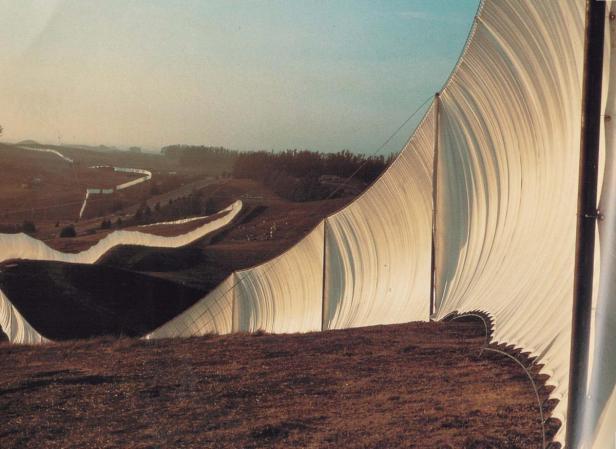 photo credit: courtesy of the Museum of Sonoma County
Christo and Jeanne-Claude's Running Fence art installation spanned both Sonoma and Marin counties in 1976.
For two weeks in September 1976, Sonoma and Marin counties were the landscape for a massive art installation. The Museum of Sonoma County is looking for support to share the story 50 years later.
Christo and Jeanne-Claude’s Running Fence project was an 18-foot-tall temporary fence made of white fabric. It ran for 24-and-a-half miles starting outside of Penngrove, crossing Highway 101 and Stony Point Road, meandering along the topography of the hills in southwestern Sonoma County.
It went through the town of Valley Ford, into Marin County, and ended in Bodega Bay near Estero Americano.
“This coming summer and fall, we'll be celebrating the 50th anniversary of the Running Fence with an immersive exhibition celebrating the project, the place, and the people that made it happen,” said Karen Wise, Executive Director of the Museum of Sonoma County, asking the board of supervisors late last year to help fund the creation and publicity for the upcoming anniversary exhibit.
“On December 15th, 1975, the members of your body, the Board of Supervisors, approved the permit for Christo and John Claude's running fence project,” said Wise. “It brought global recognition to Sonoma County.”
As Wise told county supervisors, the project was not universally welcomed by those in Sonoma County at the time, but it gained international attention.
“More than 50 ranching families gave permission for the fence to cross their land, while environmentalists and some art advocates were skeptical. The negotiations and community involvement created a unique moment in local history. It was an internationally recognized event, contributing to our region's reputation for creativity and openness to experimental art,” Wise said.
Many local people worked on the art installation, including Shirley Handy of Windsor. She spoke with the Smithsonian American Art Museum in Washington DC for its 2010 retrospective on Running Fence. She was 18-years-old in September 1976 and recalls how difficult it was to hang each fabric panel.
“It was tough because you had to carry the heavy material up and then hook up on the top, and then hook up on the sides and the bottom. The hardest part was probably putting down the, the bottom because then you also have the wind and the pressure of the wind on both sides,” said Handy.
Photos from the installation show people being lifted up into the air by gusts of wind as they tried to wrangle the fabric into place.
David Salm, a member of the board at the Museum of Sonoma County, also appealed to the Board of Supervisors for financial support for the anniversary exhibit in 2026.
“I urge you to reach into your respective tourism impact funds to collectively provide the museum with a minimum, minimum of $100,000, which will be used to drive the economic engine as only can be achieved via the cultural arts. Thank you,” said Salm.
Money is available to nonprofits via the county's tourism impact fund grants to create improvement projects. The current grant application window closes at the end of this month on February 23rd.
