
 Live Radio





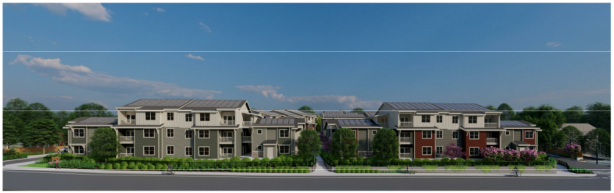 photo credit: City of Sebastopol
Design renderings of the Woodmark Apartments in Sebastopol.
An end of the year eviction is looming for some of the remaining residents at the Woodmark Apartments in Sebastopol.
Earlier this year many residents were told that if they weren't farm workers or had a farm worker living in their apartment, their lease wouldn't be renewed come January.
That's because of a requirement of a US Department of Agriculture loan associated with the project.
The Press Democrat's Marisa Endicott spoke with KRCB News' Noah Abrams about where the situation stands, with the end of the year fast approaching.
Read their conversation below:
Noah Abrams: So Marisa, you've been covering the Woodmark apartment tenant battle in Sebastopol.
The folks who live there, you know, were not aware that they were necessarily going to need to be or have a farm worker in their apartment with them to be able to keep their residency and some of them have been holding out as they've been threatened with eviction.
So you had a recent piece about it. What was the latest there?
Marisa Endicott: Yeah, and my reporting builds on a lot of reporting because this has kind of been a building situation here where essentially, actually, at this point, many of the residents took buyouts that were kind of offered in quite a hurry, but they saw it as kind of the best option in a bad situation. But there's about 14 families that have decided to kind of stick it out.
And they basically are fighting for a little bit more transparency, more information, and hopefully for a pause on them having to move until they get some more of those details they've been like asking for. Many of them are facing leases that are coming up now, middle of the month or by the end of the year and they still don't have a definitive answer on whether they need to go and when.
NA: You said in your reporting, you haven't been able to talk with the property management or the development company, or the non-profit that's associated with the project. I've hit a similar wall in my inquiries and they've just sort of fallen on deaf ears.
Have the residents said anything about the company that they're renting from and communication with them, and what they've been able to figure out besides just being offered the buyout?
ME: Yeah, I mean, aside from those buyout offers, they said they've had very little communication. One resident I spoke to, her lease was up December 15th, middle of the month. She put in her full rent for the month and they haven't said anything otherwise, but she hasn't been told as far as I know, as far as like last week that she has to go. They're kind of just in the dark here.
NA: For folks who are listening, the apartments themselves are somewhat newer. They are the very visible ones on the side of Bodega Highway in Sebastopol. Can you talk a little bit about how the project was first built and what the sort of specialized farm worker designation was created from or how it was applied to these apartments?
ME: Yeah, so the developer came in and built this first phase of Woodmark Apartments, 48 units that were supposed to be housing farm workers.
That's because they secured government funding or pursued government funding to specifically build housing for this population that has a really hard time buying for the very little affordable housing that's left. Then after the apartments kind of stood empty for months, Woodmark quietly sort of moved in a bunch of other low-income tenants.
And then about 3/4 away through their year lease, all of those tenants were told they actually have to move out so that Woodmark could stay in compliance with the loan that required them to house farmers workers. There's been a lot of kind of confusion around like what the status of that loan is. You know, a lot of questions about what do they already secure the loan? Are they trying to close the loan?
None of that have been very clear until just about a couple weeks ago when Woodmark responded to an inquiry from Sonoma County supervisor Lynda Hopkins, finally noting that they actually haven't even secured the loan. So, you know, that only added more questions because previously they had said they were seeking waivers and had been denied but of course residents are asking, you know, how did you apply for a waiver when you haven't gotten the loan?
So, you know, really there's a big lack of trust here at this point and you know feeling of really of injustice by the residents who are still there.
NA: The city decided to act. What did they do? And did the residents feel that the city's action has at least offered some kind of safety net for them?
ME: Yeah, so the city said it was limited in what it can do. They have limited control over the project itself, but as tensions rose and you kind of saw the desperation of the tenant's position, city officials did step in and pass an emergency just cause ordinance that kind of put some further restrictions on how evictions can be done. Gave a little breathing room to residents essentially.
Although, you know, ultimately it probably can't keep them housed there once their leases come up and but it did it did buy some breathing room for sure and was definitely put in place because of the situation.
NA: What are the residents like? The 14 out families that are staying put at least for the time being.
ME: Many of them are single mothers or elderly people on fixed or limited incomes. There are a few farm worker families there as well.
Really, when I spoke with people, they they kind of portrayed the situation as [them] having given up other affordable housing options to come here, or...like facing real difficulty in leaving again.
One woman I spoke to, Beth Gallock, she, you know, has been the primary caretaker for her partner who has dementia. It's really hard to move somebody in that state. It's really hard to find somewhere that could house them both. It's hard to find anywhere you can do that and afford it.
So you know, people are in a really difficult position here.
