
 Live Radio





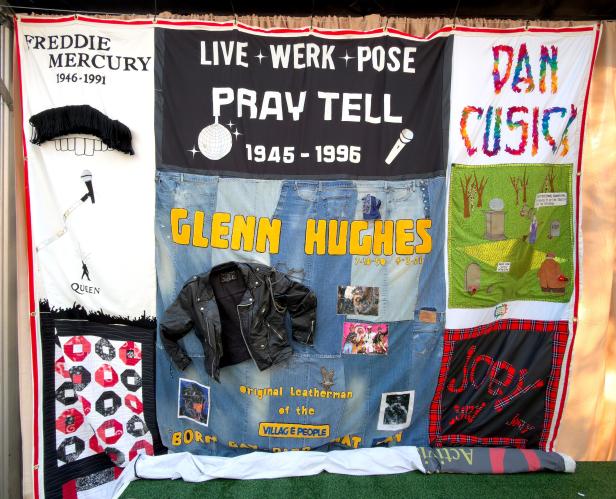 photo credit: Ruth Dusseault
An AIDS quilt is displayed during the World AIDS Day ceremony at the Nationals AIDS Memorial Grove in Golden Gate Park in San Francisco on Monday, Dec. 1, 2025.
Bay Area leaders and gay rights advocates gathered Monday in San Francisco to honor community members and commemorate World AIDS Day.
Tweed suits and feathered dresses packed into banquet seating in a tent alongside the National AIDS Memorial Grove at Golden Gate Park, the only national monument dedicated to the memory of thousands lost to the deadly disease.This year, the Trump administration did not commemorate World AIDS Day. California officially recognized the day for the first time at state level, although San Francisco has recognized the day since it was originated by the World Health Organization in 1988.
By 1986, more than 38,000 cases of AIDS were reported from 85 countries, according to a timeline from the University of California, San Francisco. UCSF faculty physicians opened the country's first outpatient AIDS clinic in 1983, as the epidemic surfaced in San Francisco and New York.
It was the memory of those early days that haunted Monday's event, back when the virus began to take lives, disproportionately impacting gay men while public acknowledgement of the crisis was delayed for years.
Two awards were presented Monday, including the National Leadership Recognition Award, which honors an individual or an organization based on their significant national impact on the fight against HIV and Aids. This year's award went to the Sisters of Perpetual Indulgence, a group that began in San Francisco by dressing in nun costumes and dedicating themselves to community service.
"We are a modern-day order of queer and trans nuns," said Sister Vish-Knew, in a video introduction describing the group's origins. "We minister to the unhoused. We feed the hungry. We counsel people in harm reduction, and we bring a lot of joy."
Past recipients include Speaker Emerita Nancy Pelosi, President Bill Clinton and actor Judith Light. This year's recognition specifically acknowledged the work that the sisters did in the early 80s and throughout the 90s around HIV/AIDS.
"We have sisters in 52 U.S. cities and in 14 countries," said Sister Roma in an interview before the event.
The sisters were the first organization to produce a safer-sex pamphlet called Play Fair. They also held one of the first fundraisers for people in the community who were sick and needed help paying rent or buying food.
"We did a condom ministry for ten years for the community to practice safer sex," said Roma. "And then we just ministered to people in the community who were sick and lonely and frightened. We sat with them and spoke and gave them a hug. That's what they needed the most, because people were afraid to touch them. There was so much fear and stigma."
According to the World Health Organization, an estimated 40.8 million people were living with HIV globally in 2024. Approximately 630,000 people died from HIV-related causes and about 1.3 million people acquired HIV the same year. According to the HIV + HEP Policy Institute, a nonprofit that monitors policies that impact the prevention and treatment of HIV and related health conditions, the Trump administration's 2026 budget did not eliminate core HIV treatment programs, but it did eliminate funding for domestic HIV programs and monitoring by the Centers for Disease Control.
"While AIDS diagnoses in San Francisco have fallen dramatically over the past decade, last years data showed a slight uptick," said San Francisco Mayor Daniel Lurie. "The increases we are seeing among African Americans and among women make clear that disparities still exist."
Along with the mayor and Pelosi, Monday's speakers included Daniel O'Day, CEO of Gilead Science, the company that makes the HIV drug Lenacapavir for treating existing HIV infections and Yeztugo, an FDA-approved injection for HIV prevention.
"Just a few weeks ago, I was in Mesopotamia and Africa to celebrate a historic moment in the history of HIV/AIDS," said O'Day. "For the first time ever, a new HIV medicine is available in sub-Saharan Africa in the same year it was approved in the United States. Infectious diseases know no boundaries. If we don't end the epidemic everywhere, we won't end it anywhere."
Also in attendance was Troy Brunet, who tearfully accepted the Thom Weyand Unsung Hero Award clad in a purple cape and broad-brimmed hat. The recognition was for his advocacy as a community volunteer. Brunet worked with Metropolitan Community Church of San Francisco and helped to establish the National AIDS Memorial Grove. Brunet has suffered multiple health challenges, including car accidents, addiction and a long coma.
"Growing up Catholic, with parents that made sure you got up every day, it's really helped me to get up every day regardless of the challenges that I have," Brunet said. "Find something that brings you some joy, and life through that each day. Even if it's a little minute thing, find it, that's the only thing that will keep you going sometimes."
