
 Live Radio





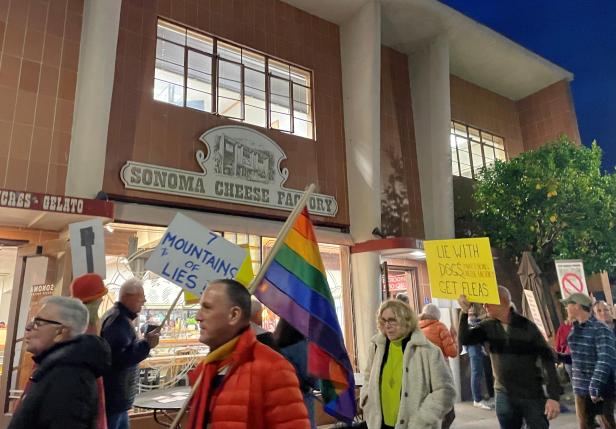 photo credit: Noah Abrams/KRCB
Protests with Wake Up Sonoma protesting Ken Mattson and Tim LeFever's influence in
Sonoma Valley outside the Sonoma Cheese Factory, when it was part of Mattson's real
estate portfolio on January 30, 2024.
Residents of Sonoma Valley and beyond have had plenty of questions about Ken Mattson's many cases in court, and so do the many investors in his real estate ventures.
The Press Democrat's Phil Barber has closely covered the years-long Mattson saga.
He's reported on everything from controversial anti-LGBT Facebook posts by Ken's wife, Stacy Mattson, to the long-running and controversial political affiliations of Mattson's longtime friend and former business partner, Tim LeFever.
LeFever's alleged close ties to conservative-right wing organizations set in motion a strong counter-reaction from some residents in Sonoma Valley.
Efforts to oppose and shed light on Mattson and LeFever's vast real estate holdings in the valley - well over 100 properties - led to the formation of Wake Up Sonoma.
The outspoken advocacy group has been a leading critic of the pair.
In May of this year, Mattson was arrested by the FBI, and accused by federal prosecutors of running a ponzi scheme with his real estate dealings.
Now, Mattson is tied up in bankruptcy court, and has been accused of fraud by LeFever.
KRCB News spoke with Barber for the latest on the bankruptcy case, and where things might be heading for Ken Mattson.
Below is that conversation between Barber and KRCB's Noah Abrams. It has been edited for length and clarity.
Noah Abrams: You have been reporting on the financial situation in the bankruptcy case of Ken Mattson, and now it's gone to bankruptcy court. So, what's going on there? It seems like per your latest reporting, the investors are looking like they might not get all the money back that they were promised, and all the money that they put in.
Phil Barber: Yeah, this whole saga has gone through several different major phases. [It] started out with allegations and questions and lawsuits where there was a lot that was unanswered. Then it entered the phase of indictment and prosecution and bankruptcy proceedings where a lot of those questions have been answered.
They're allegations, they have not been proved, but US attorneys and lawyers in the bankruptcy cases have now really presented a very strong case, I think, against Ken Mattson and the businesses that he ran.
Now I think we've entered the next phase and it's more a matter of the facts just kind of sinking in with the investors, because it is starting to look like there are assets available for creditors.
Creditors could be banks, but they could also be these individual or family investors, but it's very unlikely to compensate people 100% percent for what they say that they've put into these investments. So, it's becoming a slow process. It's getting ground out.
NA: What do some of the assets look like? Are these properties, real estate? Is this something like a luxury car that could be repossessed and sold, and the proceeds given to somebody?
PB: There's a little bit of that latter, but really we're talking real estate. These investment funds were set up to purchase real estate and ostensibly for everybody to share in the profits. If those real estate properties were sold; or some of them were commercial properties, so, if there's rents coming in, everybody was to share in that.
So, there is a portfolio when when you look at all of the LeFever-Mattson entities, that's the company that Ken Mattson started with his lifelong friend Tim LeFever. Then there's a separate company K.S. Mattson Partners, that Ken Mattson ran as a 50/50 partner with his wife, Stacy.
If you combine all of the properties from those two entities, it's over 200 sites all across the board, a huge mix, but for the most part, it includes some very valuable properties.
There's office complexes in Sacramento. There are a lot of residential and commercial properties in Sonoma, that when you add it all up are worth quite a bit of money. The question is, how much do you spend to sort out who is owed what? Because every dollar that you that you spend on that analysis is a dollar that's probably not going to come back to the investors.
But, you know, without that analysis, how do you even know who is owed what?
NA: Some of the properties have already been sold, right? And some folks are trying to pick up the developments where they were left off [because] I was driving on Highway 12 the other day in Sonoma Valley and you know, there's still some of those properties right there just north of Boyes Hot Springs right along the road that have the construction that was never finished.
PB: Yeah, the infamous Moon Mountain properties that have been in stage of half construction since before Ken Mattson purchased them for well over a decade now.
But yes, the LeFever-Mattson company went into bankruptcy first and the properties that were technically owned by LeFever-Mattson and all of its various related corporations, those were marked for real estate sales first and many of those have been sold. There's a pretty good number and a lot of them are on the market now. I think at least 40 are currently on the market and a number have been sold.
That process should start happening now with the K.S.-Mattson properties assets. That's much more based in Sonoma. The LeFever-Mattson portfolio was kind of all over California. A lot of them kind of along the I-80 corridor; Solano County and in Sacramento County.
KS-Mattson properties assets [are] heavily based in Sonoma. So we should start seeing sometime over the next few weeks or months, lot of properties being sold in Sonoma, too.
NA: What about the hard money lender, those folks Socotra Capital in Sacramento? What's happening with them and how their assets may or may not end up getting divvied up in this bankruptcy court?
PB: They've become a key figure in this whole process. So Socotra Capital, based in Sacramento, they're a private lender and they are what is referred to, as you said, as a hard money lender. Which means they'll get you your money for a property loan quickly.
[That] tends to come with a very high interest rate, 10%, 12%. And we're not talking about 15-year, 30-year loans. We're talking about loans that are come come due within, you know, a couple years often.
So very different sort of operation. They were Ken Mattson's preferred lender. They were involved in a lot of those LeFever-Mattson deals. But when the K.S.-Mattson Properties company truly controlled by Ken Mattson, when they started making their big play in Sonoma, almost all of those properties, and we're talking about at maybe 120 property purchases in Sonoma, almost all of those were financed by Socotra Capital.
So Socotra Capital would say they are owed probably more money than anyone. A lot of the investors have been very suspicious of Socotra Capital from the start and the question they ask is, did they not see that something fishy was going on here that this man kept buying more and more properties with these highly leveraged loans over and over and over again.
So in the LeFever-Mattson bankruptcy, there is a committee that was formed under the auspices of the court. It's made up of LeFever-Mattson investors or relatives of those investors and their role in the bankruptcy is basically to look out for the interest of the investors. I think they've been a pretty indispensable force in that, and they threatened to sue Socotra Capital.
Both parties met in Los Angeles for two days under the guidance of a retired judge, I believe, and they worked out a settlement. So, any property [that] is financed by Socotra Capital, that're sold out of bankruptcy, there's a complicated formula for who's going to get that money, but the first pool of money starts out with like a 75% [split] to Socotra, 25% to investors.
Then if there's money left over, it's a 50-50 split. Because I've talked to them, I know there are investors who are very disappointed in that ratio. But I think the worry amongst the investors committee and the other attorneys in the bankruptcy is that if you fought Socotra on that, it's going to cost a lot of money to litigate. You might not win and then if a property sold, you know, Socotra might just get 100% of what they're owed before anybody else gets anything. So that that was the compromise.
NA: Yeah, absolutely. Tim LeFever, obviously his political affiliations with parts of the conservative judicial movement and conservative politics within the state of California was something that raised a lot of alarm bells for some residents in [Sonoma Valley] when all of this first came to the fore.
But it seems like he's since sort of stepped away, stepped back, had a tumultuous breakup of the relationship with his long-time friend Ken Mattson. Is there anything that's been involving him since a lot of the financial situation has started to be litigated out in court?
PB: Very little and I don't know if he has adopted a lower profile because of this mess, which I'm sure is very embarrassing. I mentioned some of the suspicions surrounding Socotra Capital, believe me, there are many surrounding Tim LeFever too.
I think amongst the rank and file investors that enabled this huge huge real estate empire, I don't think you'd find too many people who believe that Tim LeFever knew nothing about this.
But I will say he came forward to federal authorities very quickly. I don't know how he made that discovery. He's never talked to me about this, but when Tim LeFever discovered [suspicious financial transactions] he did immediately go to the SEC and worked with the FBI, I think.
I think because of that operation, he's in the eyes of prosecutors, much less a person of interest than Ken Mattson. [LeFever] and his wife have filed a number of claims themselves. They were investors as well as supposed managers of these funds. So, they say they're owed a lot of money.
One interesting note, the creditors committee that I had mentioned that was formed on behalf of investors reserves the right to bring a suit against, and they lay out a number of parties, that included Tim LeFever and his wife Amy LeFever, and it also included entities such as the Capital Resource Institute, which is one of the right-wing groups that Tim LeFever has been associated with.
But as of this point, I have never had any clues that Tim LeFever is being investigated by federal authorities. He's a defendant in all bunch of lawsuits that were paused by the bankruptcy, but so far he's managed to kind of stay above the mess.
NA: Ken's other sort of legal troubles. I know that some of the reporting has become rather personal, things like him crashing his car, or...when the FBI picked him up, it was outside of his workout gym in Napa, I believe. So what's happening on that front with him, and sort of his personal life? Is he still somebody that is seen in and around Sonoma and Napa valleys or has he sort of slinked away to other parts of the state to try to escape some of the...spotlight or the press spotlight in the area?
PB: He has not been nearly as visible lately, but I do think he is still in Sonoma. I think he still works out regularly at that Orange Theory Fitness Center in Napa, where yes, he was apprehended by FBI agents in May, but he is still seen around town a little bit. The car crash was very strange.
I don't have a lot of insights into Ken Mattson's personal life. The people I talked to related to this case, they are people who did know him. He came to their living rooms. They had a relationship where they could text with him, but that has ceased for a long time now. So, I don't know people really who continue to have direct contact with him. So, it's all kind of guesswork.
There was a spectacular car crash, I think it was in late August, that there still doesn't seem to be a great explanation for. Ken Mattson basically said he left the gym in Napa and next thing he remembered was he was being pulled out of his crumpled SUV by first responders and he wound up airlifted to a hospital, but also seemed to be okay and only had minor injuries. So [that] adds to the mystery of all of this.
NA: Phil, lastly, [do] you hold out any hope that one day Ken [Mattson] or Tim [LeFever] will be willing to sit down and speak with you? You seem to have looked into their lives in a way that I think they were never expecting.
PB: Man, I would I would love that. I've offered many times and lately I haven't offered as much because it felt like, you know, just a voice in the wind. But I definitely continue to hold out hope that someday Tim LeFever will speak to me. I think that would be fascinating.
I think he could add so much perspective to this that even the investors who have followed this relentlessly might not know in full. I don't know if there's a chance of that. I can't imagine Ken Mattson would talk to me at this point. I would love it if he did. To this point, he's not expressed any remorse either publicly or really to the investors he has talked to at least, you know, as they've related to me.
I'm very curious to know what his thought process is now. Obviously, like this must really be affecting his family as well. He has children, adult children in Sonoma, and elsewhere and, you know I'm sure it's been very hard on the family.
I would love to talk to him about all of that. I don't hold out tremendous hope for it.
NA: Well, Phil, thank you so much as always for your really thorough and detailed explanations of this case.
PB: Great to talk to you, Noah, as always.
